


Oxymon
A user-
Oxymon
Measure oxy-
FEATURES
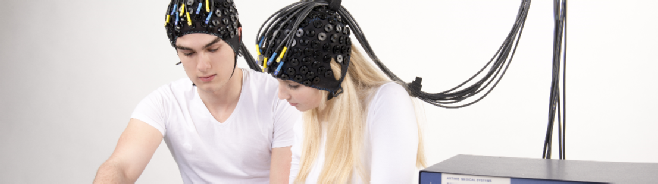
The OxyMon Mk III is a user-
Highlights
- Stable, versatile and highly sensitive
- Possible to measure on both brain and muscle tissue
- Numerous configurations, from 1 to 100+ channels
- Fast data collection at 50 Hz as standard -
up to 250 Hz possible, for any amount of channels - No need to screen against ambient light
- Unlimited data storage
- The light detector cannot be damaged by ambient light
- Raw data (optical densities) easily accessible
- Up to 4 wavelengths per channel
The technique
Near infrared spectroscopy, (NIRS), the technique on which the OxyMon is based, relies mainly on two characteristics of human tissue. Firstly, the relative transparency of tissue for light in the NIR range, and secondly on the oxygenation dependent light absorbance of hemoglobin.
Technical Specifications
- Technology: Continuous wave near infrared spectroscopy using modified lambert-
beer law. - Measurement: Changes in oxy-
deoxyhemoglobin and optionally regional tissue saturation index (TSI) using spatially resolved spectroscopy. - Data analysis software: Oxysoft.
- Operating system: Windows 7, 8, 10
- Light source(s): Temperature stabilized pulsed laser sources (class I, IEC-
60825- 1, safety of lasers) - Optode holders: Multiple distances for muscle or head possible, multichannel generally customer specific.
- Optode distance: Depending on application. Frontal head up to 6 cm possible with arterial pulsation still visible. For fnirs 3-
4cm is recommended. - Environment: Operating temperature: ~10-
27 °c. Both source and detector are temperature stabilized. - Altitude: 0-
5750 m. - Dimensions: Weight: 7 to 8 kg, wxdxh: 37x30x9 cm
- Channels: Between 1 and 112.
- External inputs: Optional are 8 additional analog inputs at 50 Hz (250 Hz optional), ± 4 volt.
- Storage: Real-
time, unlimited data storage. - Detectors: Temperature stabilized and cooled avalanche photo diodes with ambient light protection.
- Wavelengths: Standard nominal 765 and 855 nm, other wavelengths are possible.
- Interference: We can deliver NMR compatible fibers for compatibility with MRI. EEG/ECG does not interfere the optical signal.
- Power: Auto sensing: 110-
240 v, approx. 40 Watt. - Accessories: AD input/output box
AD board: Portasync
Parellelsync cable
Oxysoft 3D extenstion.
- NIRS + EEG: Oxymon + TMSI EEG package (16 channels or more).
- NIRS + EMG: OxyMon + TMSI EMG package (2 channels or more).
- NIRS + Eyetracking: OxyMon + Tobii eyetracker.
Click on your language to download either a English or Spanish version of the leaflet with more information.
Note: Artinis NIRS products are intended to be used for research applications only. Our products are not sold as Medical Device as defined in EU directive 93/42/EEC. Our products are not designed or intended to be used for diagnosis or treatment of disease.